As I mentioned in a previous post, one of the unexpected challenges in putting the course together (which I'm hoping to release at the end of August or early September) has been answering a deceptively simple question:
What is it about a particular piece of music that makes it appropriate for one stage of a Holotropic Breathwork session and not another?
Traditional ways of describing music - genre, instrumentation, tempo or even mood - only take us so far. Two orchestral pieces can serve completely different purposes within a breathwork journey. Likewise, an electronic track and a piece of traditional drumming may occupy exactly the same place in the arc of a playlist, despite sounding nothing alike.
What we're really listening for isn't the style of the music. It's the qualities that sit underneath it.
One of the reasons music is such an extraordinary phenomenon is its ability to help us feel. Rather than thinking about music in terms of genre or instrumentation, I've been exploring whether it might be more useful to think about it in terms of four underlying vectors that describe how a piece of music behaves within an expanded state of consciousness.
An example playlist
The screenshots below show the various arcs of these four vectors for a truncated playlist that I use int he course to describe the arc of the music.
Affective intensity
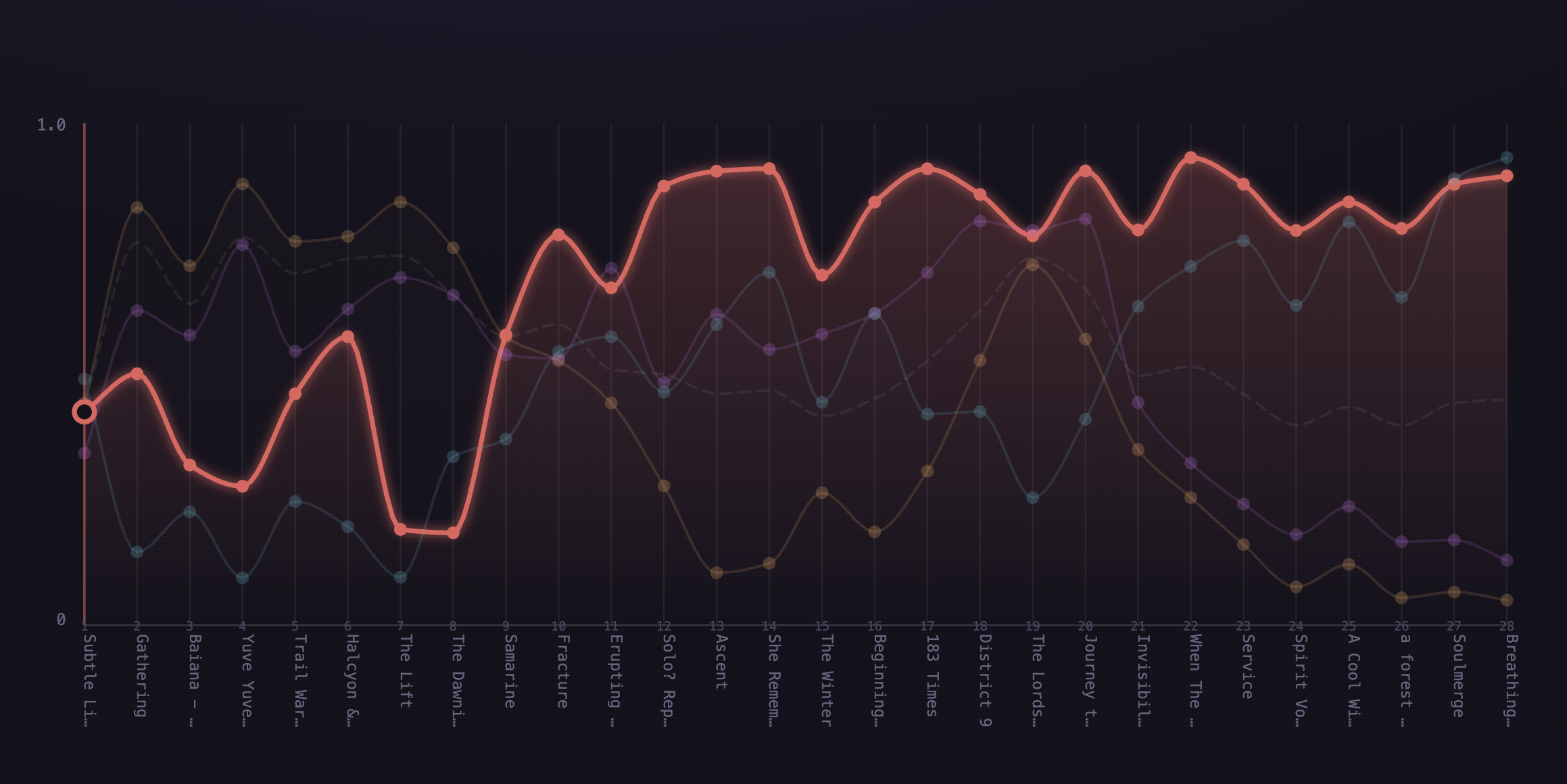
How emotionally evocative is the music? Does it gently invite emotion, or does it carry enormous emotional weight? Affective intensity includes both "happy" and "sad" types of emotion (or whichever emotional polarity you would like to choose).
As you can see affective intensity exists more or less throughout the entire set just at significantly smaller values in the first hour.
Activating intensity
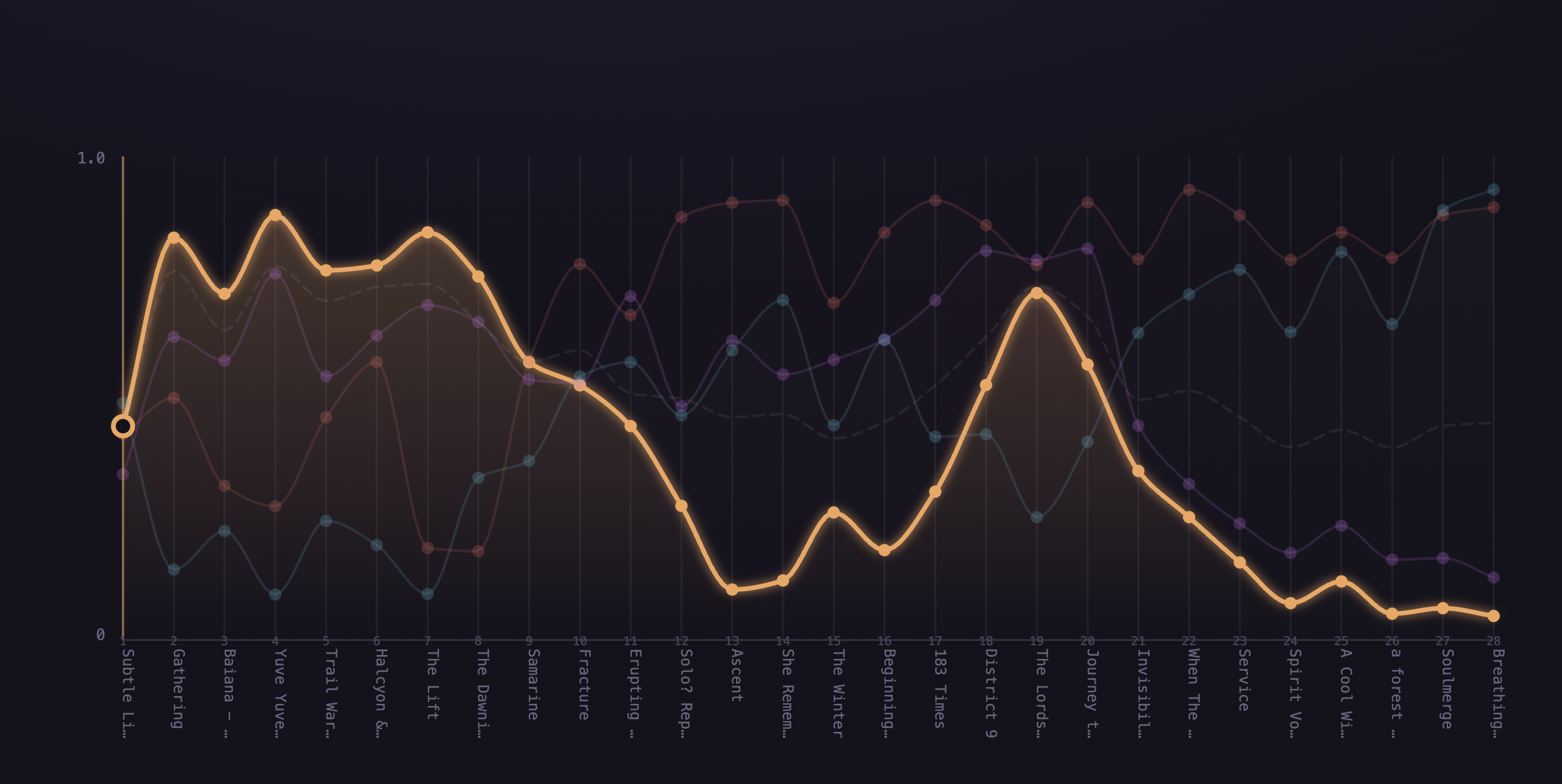
How much energy or momentum does the music generate? Does it encourage stillness, movement, struggle or expression?
Activating intensity is used throughout the first hour and then more noticeeably in th elead up to the breakthrough and then gradually recedes as the third hour unfolds.
Tension
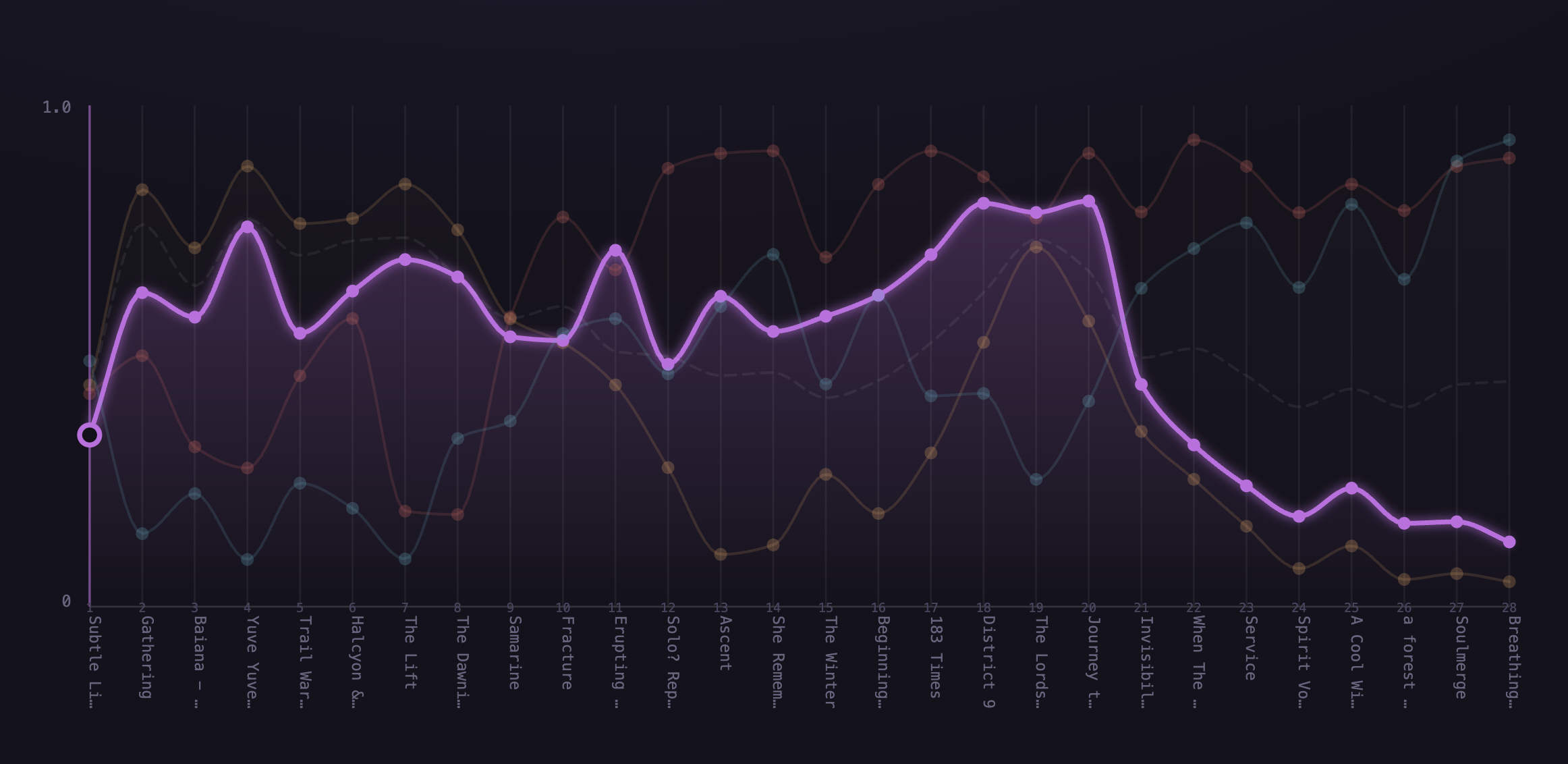
How much anticipation, uncertainty or unresolved movement exists within the music? Does it create a sense that something is building or seeking resolution?
Tension is present, in varying degrees, throughout the journey right up until the breakthrough. It provides the momentum and forward movement that supports the breather's process, creating a sense that something is still unfolding. As the breakthrough is reached, the tension begins to dissolve, giving way to greater spaciousness and release.
Spaciousness
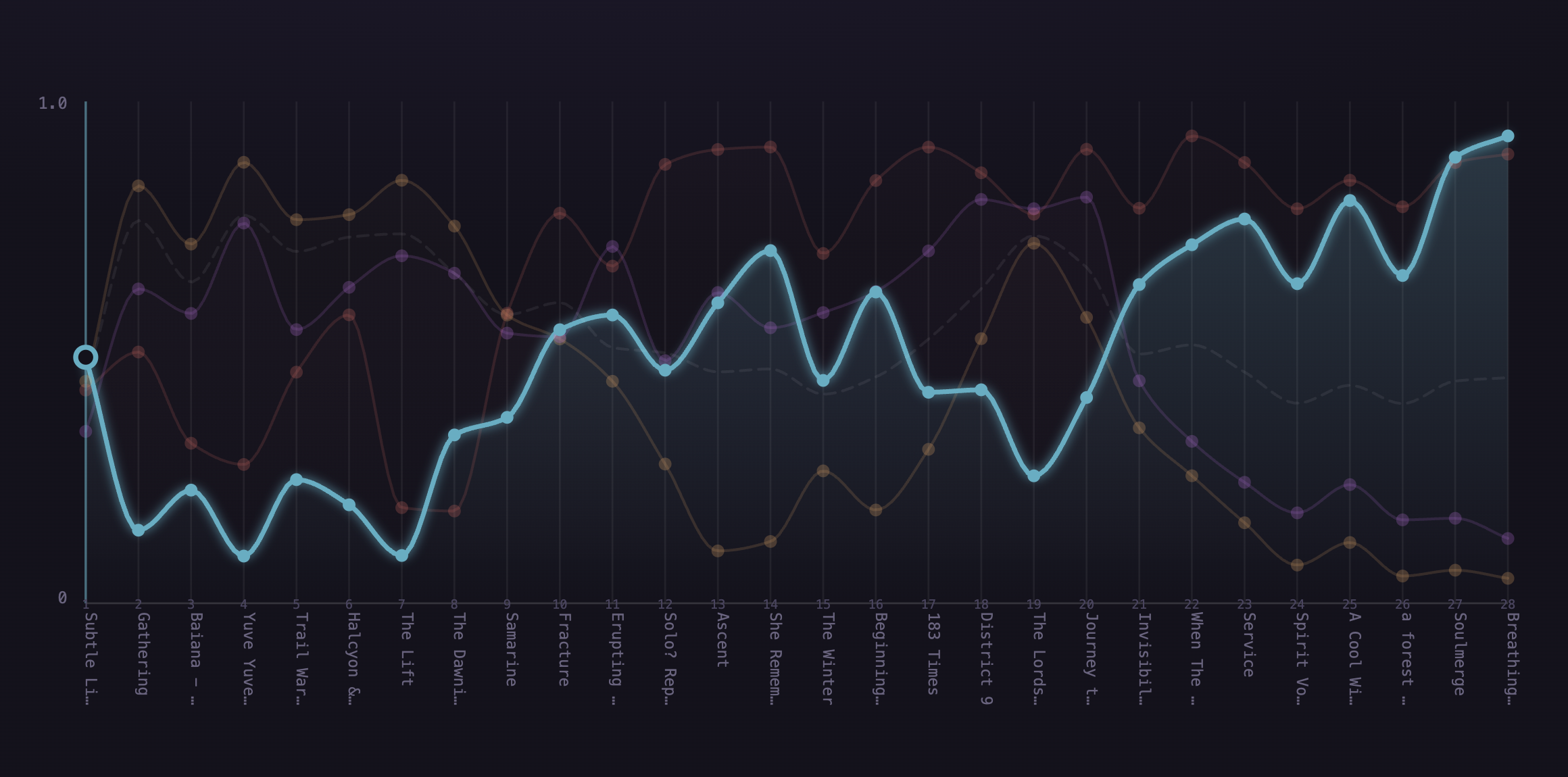
How much openness, expansion and room to simply be does the music provide?
As you can see there is a significant amount of spaciousness in the call to adventure at the start and then an opening int he second hour with an increase in spaciousness right until the end of the third hour.
These aren't rigid categories, nor are they intended to replace the rich language of music itself. Rather, they provide another way of listening—one that is perhaps more aligned with the needs of breathwork facilitators than traditional musical analysis.
The combination of these vectors
While each of these vectors can be considered independently, it is their combination that gives each stage of a Holotropic Breathwork playlist its distinctive character.
Music in the Call to Adventure often blends activation, spaciousness and growing emotional intensity, inviting the breather into the journey without overwhelming them.
As the session moves towards the Breakthrough, affective intensity, activation and tension work together to support the final ascent and the possibility of transformation.
In the Third Hour, the emphasis shifts towards affective intensity and spaciousness, allowing the breather to rest, integrate and remain with whatever has emerged, without the driving force of tension that characterised the earlier stages.
The balance of vectors
One of the interesting things that has emerged is that these qualities often change independently of one another. A piece can be highly activating without being emotionally intense. Another may carry enormous affective depth while remaining slow and spacious. A breakthrough piece may be just as powerful as the music that precedes it, but with much less tension and considerably more spaciousness.
Thinking in this way has also helped me understand why creating a Holotropic Breathwork playlist is such a different process from simply assembling a collection of beautiful music. The facilitator is not only selecting individual pieces—they are shaping the movement of these four vectors across two and a half to three hours, gradually creating a musical environment capable of supporting the unfolding of a wide range of inner experiences.
Whether these four vectors ultimately become a useful way for others to think about music remains to be seen. But they've already changed the way I listen, curate and teach. More importantly, they've given me a language to describe something that, until now, has often been communicated largely through intuition and experience.
If this interests you checkout the details of the Music for Breathwork course.