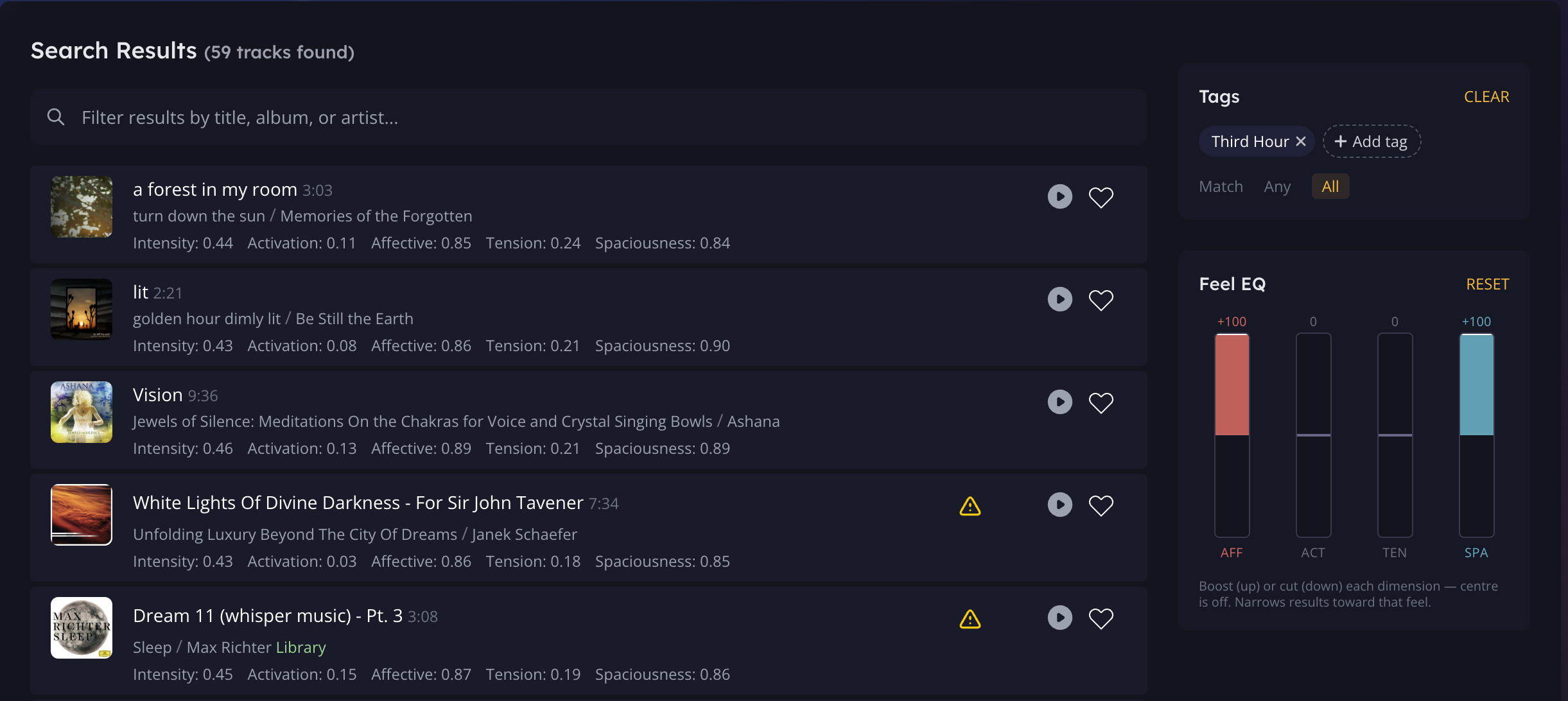
I've decided to remove that subscriber restriction.
From today, Track Search is available to everyone, whether you're a subscriber or simply exploring the catalogue.
The reason is simple. The catalogue has grown to the point where browsing page after page of music isn't always the best way to discover tracks. The search tools have become one of the most useful parts of the site, and I'd like more people to experience what's possible.
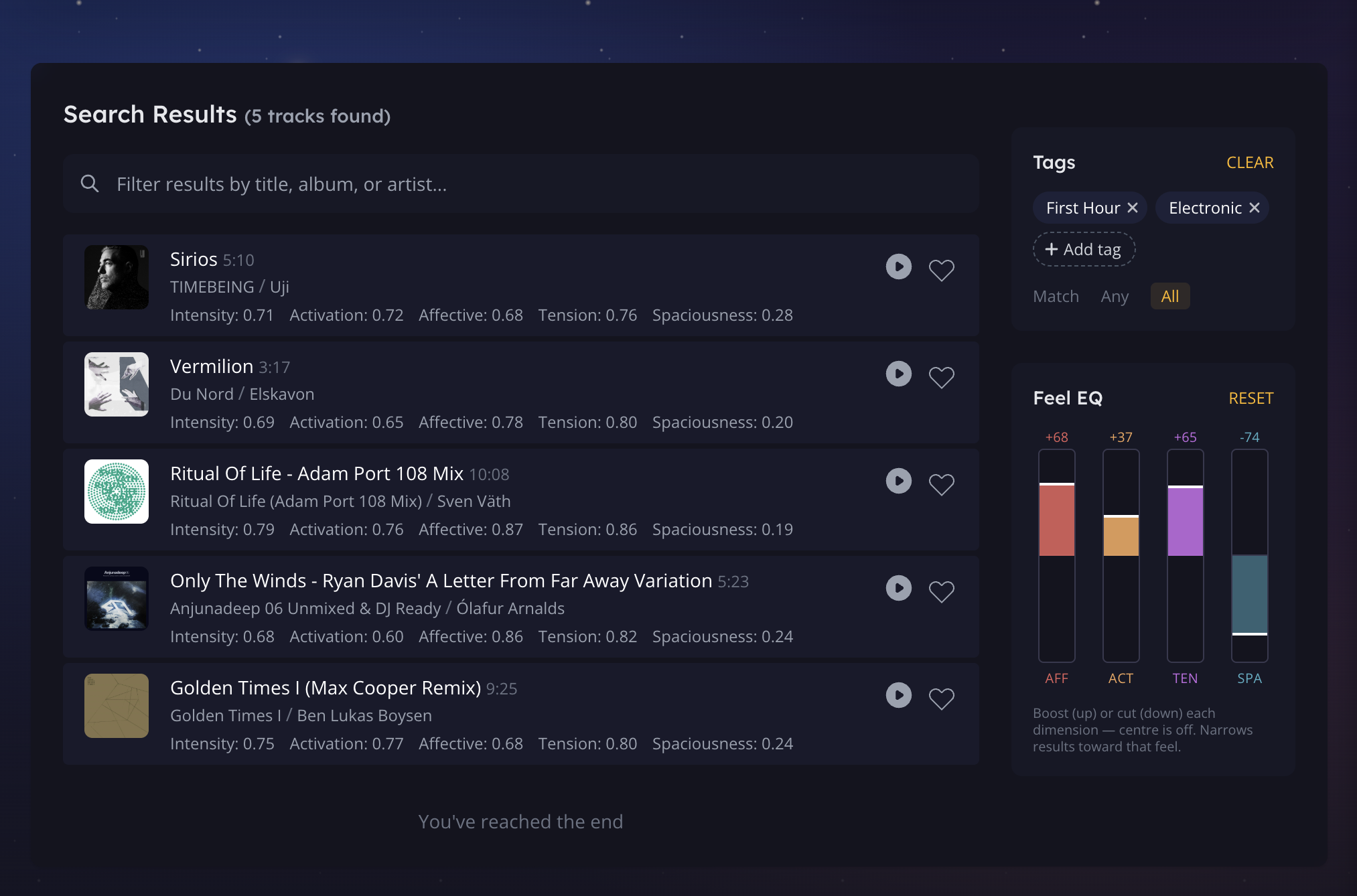
Along with opening up Track Search, I've also released an update that makes one of the catalogue's more interesting features much more visible: Feel EQ.
Rather than searching for music based solely on genre, instrumentation or other technical characteristics, Feel EQ lets you explore the catalogue according to how the music is experienced.
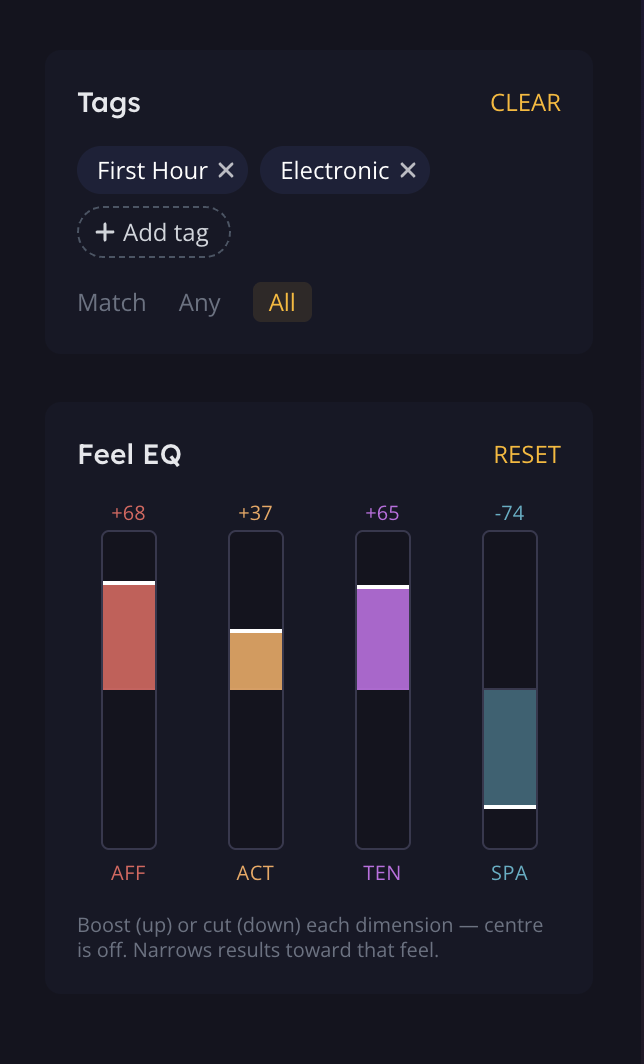
It consists of four sliders:
- Affective Intensity
- Activating Intensity
- Tension
- Spaciousness
As I continue writing the Music for Breathwork course, I've found myself returning to these four dimensions again and again. They seem to capture something fundamental about the way we experience music, particularly in Holotropic Breathwork.
Most descriptions of music focus on objective characteristics. Is it orchestral or electronic? Fast or slow? Loud or quiet? Those qualities certainly matter, but they don't necessarily tell us what it feels like to breathe with a piece of music.
Feel EQ is an attempt to map those subjective qualities.
The real strength of the system is that it works alongside the existing search tools rather than replacing them. You can still filter by tags, audio features, artists or track names, then refine those results using Feel EQ.
For example, you might search for Second Hour tracks tagged Modern Classical, then use Feel EQ to find pieces with Activating Intensity above +70 and Tension above +60. Or perhaps you're looking for spacious ambient music with low activation but high affective intensity. These kinds of combinations are difficult to express with genres alone, but they're easy to explore with Feel EQ.
Over the past few years I've listened to every track in the catalogue multiple times while assigning these values. Although there is inevitably some subjectivity involved, the process has become surprisingly consistent. More importantly, I've found these four dimensions often describe the experience of a piece of music far better than genres or audio features alone.
I don't see Feel EQ as a finished system. Like the catalogue itself, it's something that will continue to evolve as I deepen my understanding of music in expanded states of consciousness. I suspect these four dimensions will become an increasingly important part of the Music for Breathwork course, because they offer a language for discussing music that goes beyond genre, tempo or instrumentation.
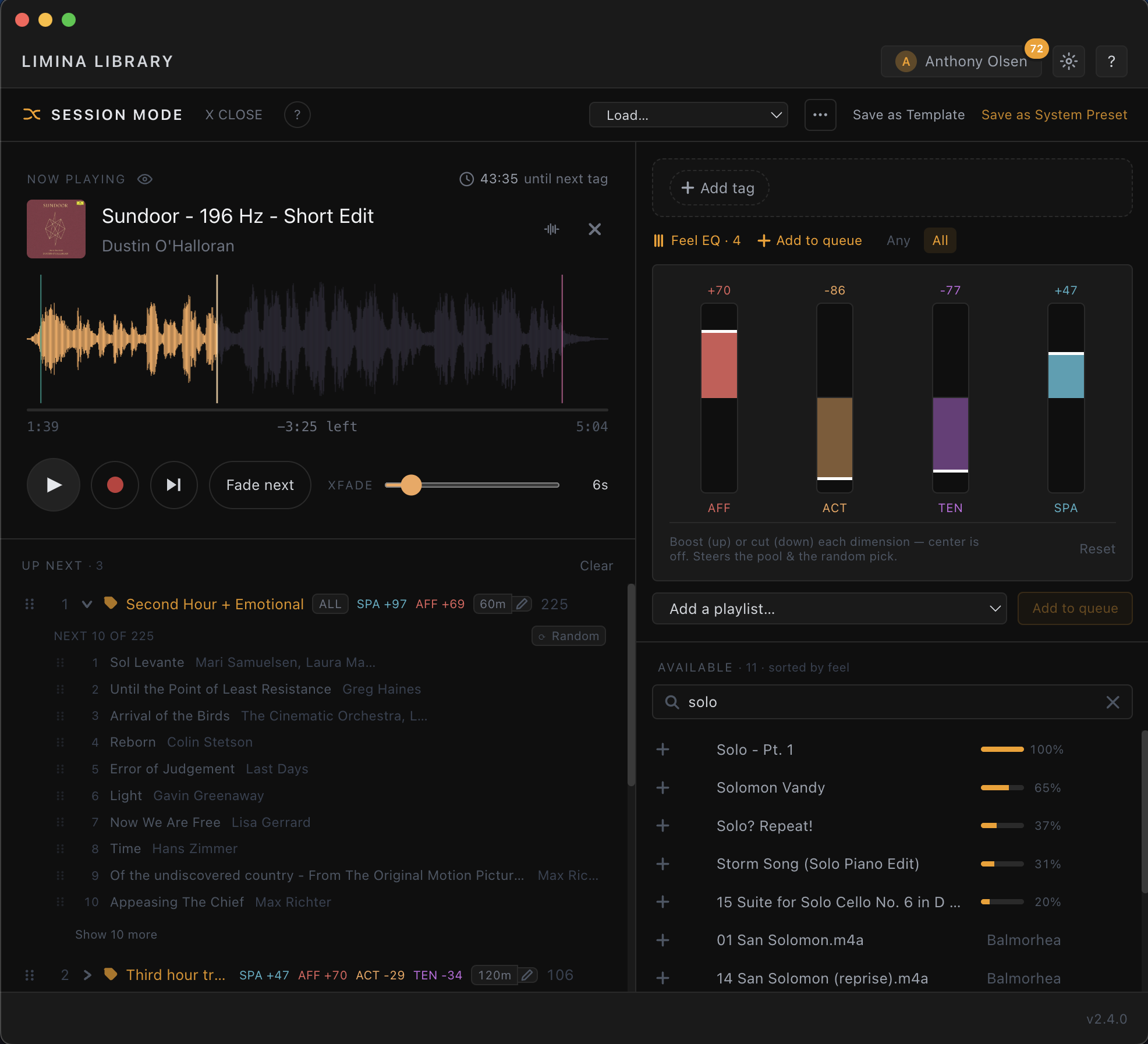
This update also brings the same Feel EQ functionality to Limina Library session mode. Both catalogues now use the same four-dimensional model for exploring music by its felt qualities, making it easier to move between collections while using a consistent way of thinking about music. Whether you're building a playlist for Holotropic Breathwork, psychedelic-assisted therapy, or simply exploring music for expanded states of consciousness, the experience of searching by feeling rather than genre is now available across both platforms.
Whether you're a long-time subscriber or visiting the site for the first time, I hope opening up Track Search and Feel EQ makes the catalogue easier to explore and perhaps encourages you to think about music a little differently.