The Call to Adventure is the opening moment of a Holotropic Breathwork set. Before the breath has deepened and before the journey has truly begun, this is the music that extends the first invitation.
It signals to the breather that something significant is about to unfold and gently draws them toward their inner experience. Like the beginning of any great journey, it carries a sense of possibility, mystery, and quiet anticipation but the overall quality of this stage of the set is that it should be invitational.
The first piece sets the tone
The Call to Adventure is typically a single track, though in some cases two shorter pieces may be combined to build a more layered sense of mystery and invitation. The music here is never confronting or overwhelming. Its role is to create an open, receptive space in which the breather feels curious and gently empowered to move inward.

The invitation can take many forms
Tracks used in this phase may take different forms: a slow-building piece that gradually gathers momentum, a world music track with gentle drumming that escalates softly, or something more atmospheric and mysterious that carries a sense of beckoning. Whatever the specific character of the music, the emotional register is consistent: this is an invitation, not a demand. The breather should feel drawn forward rather than pushed.

An interactive analysis
Click on the image below to view five pieces that we have selected that characterise the Call to Adventure stage of a set.
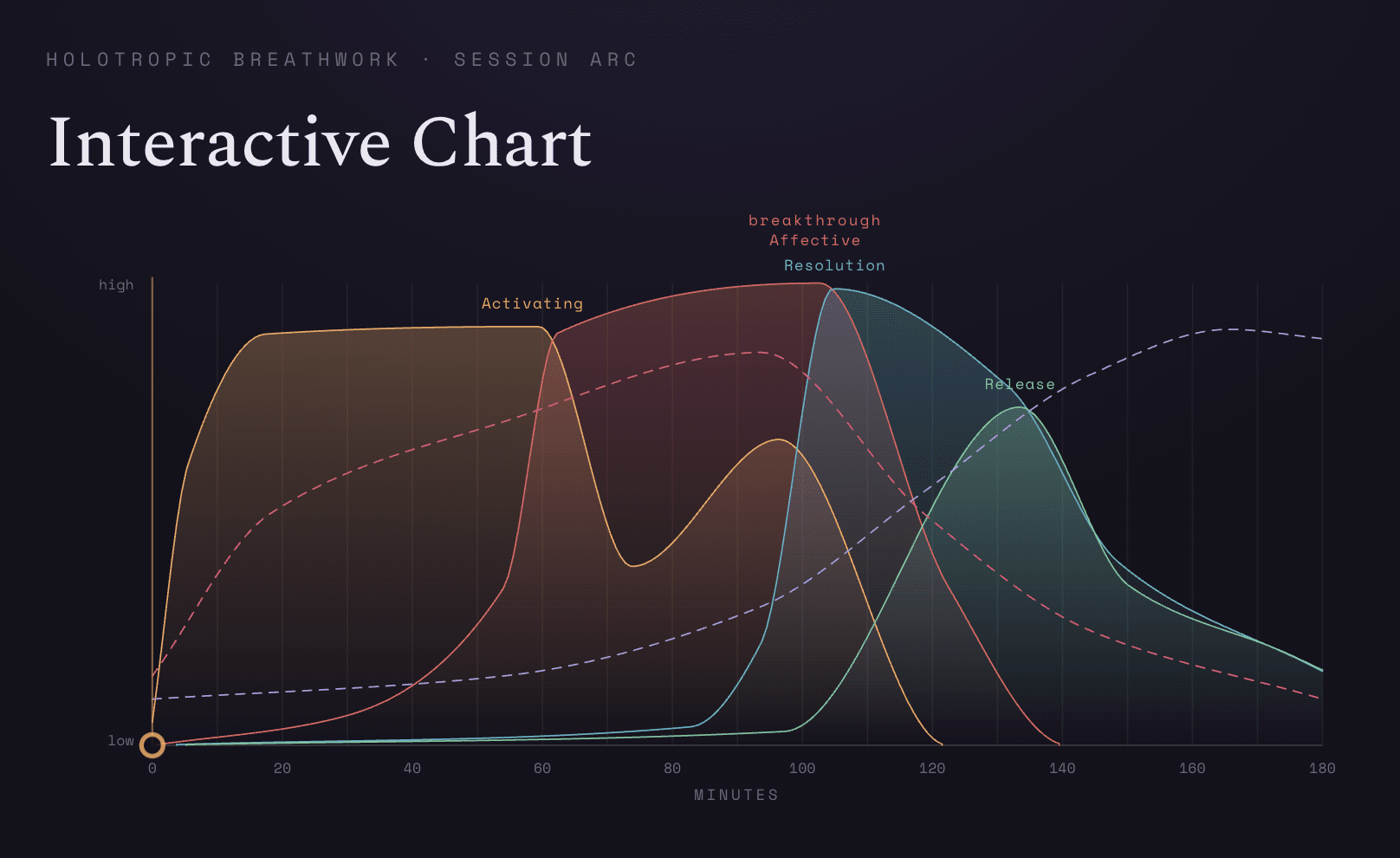
Notice how each of the tracks have an almost equal amount of activation,emotion, tension and spaciousness. Some of the pieces have a high level of affective intensity and spaciousness. We will see in later lessons for the first hour how a lot of the tracks are focussed on activating intensity and affective intensity only starts to come back in as we transition into the second hour.
Characteristics
When selecting tracks for this phase, look for:
- A gentle or gradual opening quality, nothing that arrives at full intensity immediately
- A sense of mystery, curiosity, or anticipation in the texture and tone
- Tracks that build or gather momentum rather than staying static
- World music elements, atmospheric textures, or organic instrumentation that feel open and inviting
- Emotional warmth and safety, the breather should feel held and encouraged
- Avoid anything jarring, dark, fearful, or rhythmically aggressive at this stage
Mixing Considerations
The Call to Adventure typically begins in silence or near silence, so the opening of the track itself does a lot of the work. The track can be set to fade up in the mix or you can do this manually in the room. The overall volume of the call to adventure track should be a little lower than anything that follows, perhaps fade the track to 80% of the volume and then after a few minutes bring the track up to full volume.
The video above shows the slow introduction of minimal yet interesting percussion. The piece Anahata by Sound Ambassador is a minimal composition that combines gentle rhythmic complexity with curiosity, nature sounds, and soft synthesizer pads.

It opens slowly and does not evolve dramatically beyond its initial starting point. However, the rhythmic structure and percussion elements remain gentle, assured, and steady throughout. At just over 14 minutes long, it would be advisable to fade this track out at around the five-minute mark.
The “Call to Adventure” is an invitation, and sometimes it does not take long for the breather to accept that invitation. If the pace remained unchanged for the full 14 minutes, it may begin to feel as though the invitation has not been heard or responded to.
Is the Call to Adventure just one track?
Sometimes you may like to combine tracks to comprise the Call to Adventure phase. If combining two shorter pieces, consider how they connect tonally and energetically, the second should feel like a natural deepening of the first rather than a change of direction.
The end of this phase should flow naturally into the Jumpstart, so be mindful of where the track lands energetically and how you will carry that forward into the next piece.
